Bridge Condition Assessment: Quantitative Structural Health
We look beneath the aesthetic surface of viaducts and overpasses to quantify the real physical capacity of primary load-carrying components, converting subtle material deterioration into verifiable health indices.
The Science of Quantifying Material Deterioration
A bridge does not fail without warning. Long before a crack breaks the deck waterproofing or a deflection becomes perceptible to drivers, microscopic chemical and physical processes transform the internal matrix of materials. In reinforced and prestressed concrete structures, atmospheric carbon dioxide diffuses through concrete pores, progressively neutralising alkaline passivating layers around embedded reinforcing steel. Once carbonation reaches the rebar, oxygen and moisture trigger galvanic corrosion, producing rust products that occupy up to six times the volume of the parent metal.
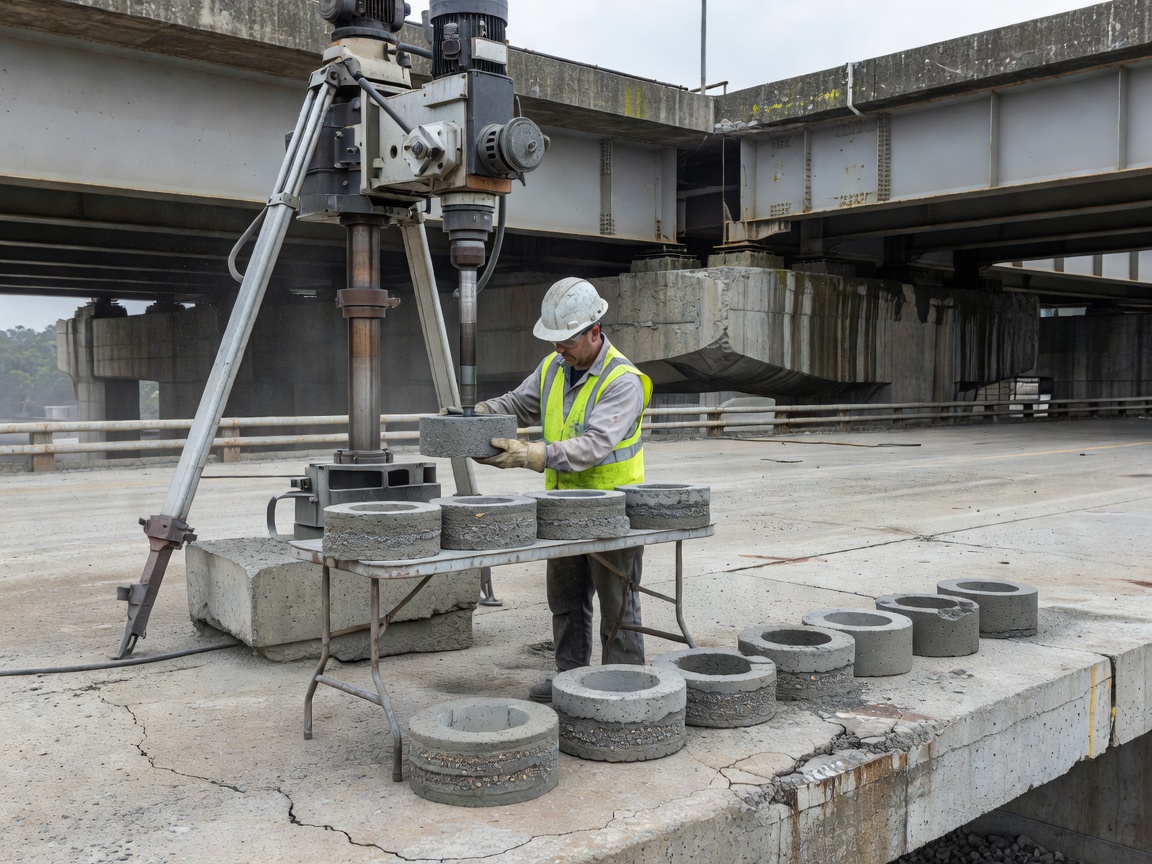
When assessing a structure across European motorway or railway corridors, our objective is to measure this exact boundary between unblemished performance and active degradation. We do not rely on visual intuition alone; we apply standardized phenolphthalein indicator sprays to fresh concrete drill cores to determine carbonation depth to the millimetre. We pair this with half-cell potential mapping (using copper-copper sulfate or silver-silver chloride reference electrodes) to trace active corrosion hotspots across deck cantilevers, splash zones, and pier stems long before surface spalling emerges.
On European transit arteries exposed to winter deicing salts, chloride ion concentration at rebar level is the single most critical predictor of premature failure. A threshold as low as 0.4% chloride by mass of cement is frequently sufficient to destabilise protective ferric oxide layers, making depth-profile dust sampling mandatory during comprehensive assessments.
Core Component Analysis: Where Bridge Failures Begin
Every bridge is an interdependent kinetic system. We break down the condition assessment into defined component categories to ensure no structural element is appraised in isolation:
- Elastomeric & Pot Bearings: Bearings must accommodate longitudinal thermal contraction, rotation under live axle load, and transverse wind forces. We check for elastomer bulging, shearing distortion, unseating, PTFE sliding layer tear-out, and corroded sole plates. A frozen bearing transfers enormous unintended horizontal bending moments into substructure piers.
- Expansion Joints: Often described as the primary vulnerability in any elevated structure. Leaking modular or finger joints allow salty runoff water to cascade directly onto bearing shelves, pier caps, and prestressed beam anchorages, generating severe hidden section loss.
- Prestressed Concrete Deck Girders: We inspect bottom flanges and tendon anchor blocks for longitudinal splitting cracks, efflorescence, rust staining, and acoustic voids indicative of poor duct grouting.
- Steel Truss Members & Girders: We monitor gusset plate distortion, pack rust between laminated plates (which can force rivets into tension failure), and fatigue cracking near connection stiffeners and cross-frame diaphragms.
- Piers, Abutments & Footings: In hydraulic environments, bridge piers face scour vortexing around their foundations, scouring away riverbed sediment and undermining spread footings or exposed pile caps.
| Component | Typical Degradation Mechanism | Diagnostic Tool / Methodology | Urgency Indicator |
|---|---|---|---|
| Deck Cantilever Slabs | Chloride ingress, rebar spalling | Half-cell potential, covermeter surveys | Rust weeping, hollow sounding under delamination chain |
| Elastomeric Bearings | Elastomer splitting, shear strain limit | Optical gauge, laser displacement scan | Shear angle exceeding 35°, bottom plate unbonding |
| Expansion Joints | Extruded seal rupture, anchor loosening | Acoustic impact testing, tactile probe | Water seepage dripping onto pier cap below |
| Structural Steelwork | Atmospheric pitting, pack rust, weld fatigue | Ultrasonic thickness gauge, eddy current testing | Measurable loss exceeding 15% of flange thickness |
| Substructure Footings | Hydraulic scour, riverbed scouring | Bathymetric sonar, sub-aquatic probe rods | Loss of bed material below pile cap datum |
Standardised Condition Scoring Frameworks
European road and rail authorities employ numerical or alphabetical rating systems to aggregate component scores into an asset-level condition index. In general terms, components are classified into five distinct health bands:
- Condition 1 (As New / Negligible Wear): Superficial hairline shrinkage cracks or minor paint scuffs with zero functional impairment.
- Condition 2 (Minor Deterioration): Localised surface rust or minor concrete staining where protective coatings are beginning to weather, but load capacity is unaffected.
- Condition 3 (Moderate Defect): Observable section loss in secondary members, joint leakage, or carbonation approaching reinforcing depth; requires programming within multi-year rehabilitation budgets.
- Condition 4 (Severe Defect): Primary load-bearing reinforcement exposed and corroding, bearing displacement near permissible travel limits, or fatigue cracking in tensile zones; demands immediate load re-rating and intermediate temporary shoring.
- Condition 5 (Critical Impairment): Imminent danger of member loss, gross structural deformation, or complete foundation scour undermining; triggers immediate lane closures or total crossing isolation.
Field Diagnostic Checklist
Before issuing our definitive assessment synthesis, we audit the following physical criteria on-site:
- Complete covermeter scanning to verify design concrete cover thickness vs actual as-built placement.
- Acoustic chain drag sounding across all accessible deck surfaces to isolate subsurface delamination domes.
- Ultrasonic velocity measurements across suspicious cold joints or Honeycombing patches.
- Calibration of bearing rotation angles against ambient temperature records at time of measurement.
- Chemical depth titration for carbonation and water-soluble chloride ion concentrations.
An objective condition assessment does not merely produce a catalogue of flaws. It delivers the mathematical foundation for structural recalculations, residual lifespan forecasting, and precision-targeted repair interventions.