Structural Bridge Inspection: Hands-On Physical Verification
True structural certainty demands arm's-length tactile scrutiny. We put experienced structural inspection engineers directly alongside steel connection nodes, post-tensioning anchors, and abutment shelf bearings.
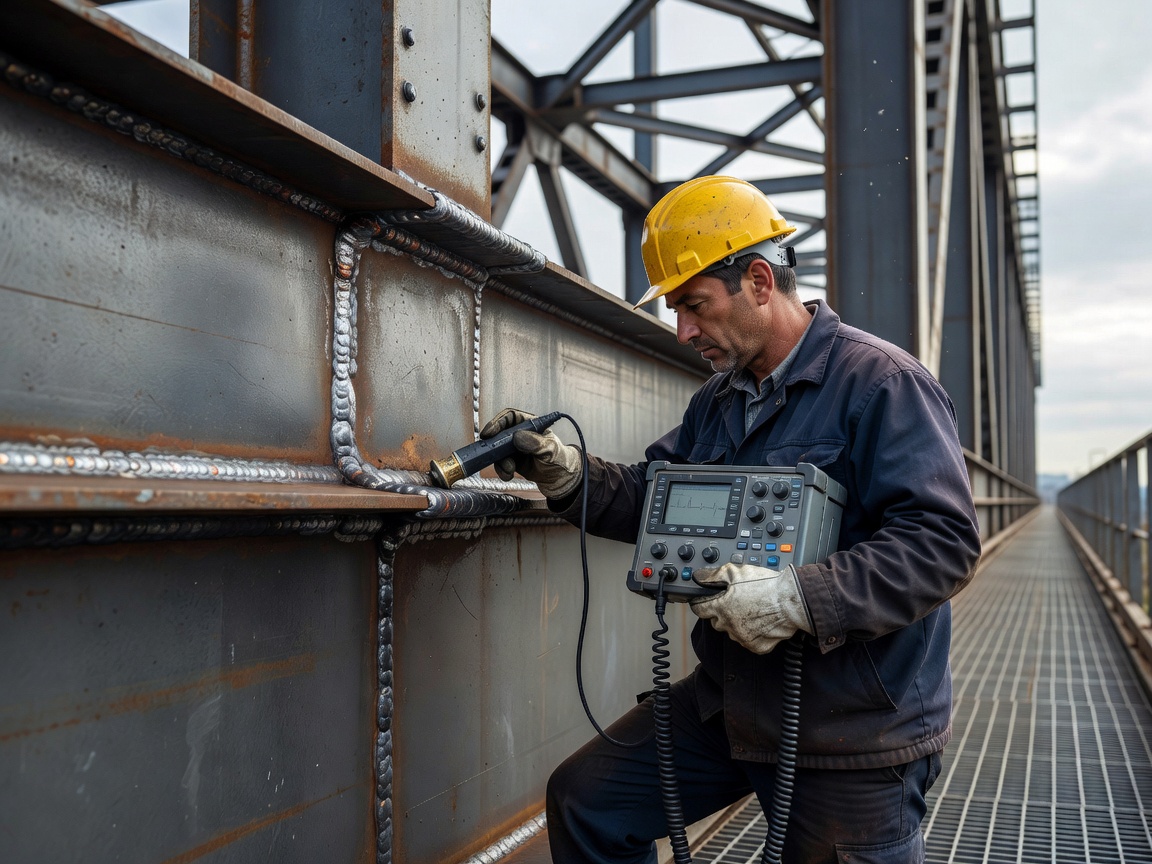
The Mandate for Arm's-Length Tactile Scrutiny
In bridge engineering, there is no substitute for close physical proximity. High-resolution optical cameras and aerial drones have transformed preliminary surveys, but they cannot feel the vibration resonance of a loose high-strength friction grip (HSFG) bolt, detect subsurface hollow debonding beneath polymer deck waterproofing with an inspection hammer, or measure the razor-thin opening of a fatigue crack under dynamic heavy vehicle passage.
Our structural bridge inspections are structured around strict European principal inspection regimes (such as those prescribed under national equivalents of DIN 1076, BD 63, or SNCF infrastructure standards). A Principal Inspection requires 100% of all structural elements to be brought within arm's reach of a qualified bridge inspector. This means every individual stiffener, weld toe, cross-diaphragm, pinned hanger, and bearing dowel is physically touched, cleaned of grime or bird guano, and scrutinized under proper task illumination.
Access Engineering & Operational Safety
Reaching critical structural nodes suspended 50 metres above a roaring river or an electrified railway line requires sophisticated access planning. We do not gamble with site safety or corridor disruption. Our inspection deployments utilize three primary access paradigms:
- Under-Bridge Inspection Units (MOOG / Barin Units): Truck-mounted articulated gantries that unfold from the bridge deck over parapet barriers, deploying a working platform directly beneath the soffit. This allows inspectors to traverse hundreds of metres of continuous box girder or beam soffits without scaffolding.
- Industrial Rope Access (IRATA Certified): For high pylons, arch ribs, suspension bridge stay cables, and steep gorge abutments, dual-rope technique allows agile, three-dimensional mobility with minimal surface impact and zero traffic lane occupancy on the deck below.
- Confined Space Box Girder Entry: Inspecting internal voids of prestressed concrete or steel box girders requires calibrated multi-gas monitors, continuous forced-air ventilation, intrinsically safe lighting, and certified top-man safety sentries. Inside, we examine internal prestressing cable ducts, diaphragm anchor blocks, and deck drainage pipes.
A fracture-critical component is any steel tension member or component whose individual failure would result in the catastrophic collapse of the entire bridge span. Our inspectors treat every tension flange, hanger bar, and pinned link eye-bar with magnetic particle testing (MT) and phased array ultrasonic testing (PAUT) to catch sub-surface fatigue initiation before propagation.
Material-Specific Inspection Protocols
Different structural materials present distinct deterioration mechanisms that require specialized field detection protocols:
1. Reinforced & Prestressed Concrete
Beyond mapping crack widths using optical crack comparators, we pay intense attention to tension zone crack orientations. Diagonal 45-degree cracks near shear keys indicate serious web shear distress. Horizontal cracking along rebar planes signals burst cover due to expansive corrosion products. For post-tensioned members, we examine end anchorage zone concrete for crushing, spalling, or micro-cracking caused by secondary anchor stresses.
2. Structural Steel & Composite Systems
In structural steel bridges, corrosion is rarely uniform. It concentrates where water collects: bottom flanges, flat gusset plates, horizontal lattice angles, and around bolt heads. We utilise magnetic thickness gauges to establish remaining parent metal thickness vs nominal specifications. Weld toes at lateral gusset connections are wiped clean and subjected to dye penetrant inspection (DPI) to identify active fatigue micro-tears.
3. Historic Masonry & Brick Arches
Across thousands of European railway corridors, masonry arch viaducts continue to carry modern axle loads. Our tactile inspections evaluate ring separation (where concentric masonry courses detach due to cyclic barrel flexure), mortar washout from persistent water seepage, diagonal shear cracks across spandrel walls, and outward barrel thrust against abutment foundations.
| Inspection Tier | Standard Frequency | Physical Access Degree | Primary Diagnostic Objectives |
|---|---|---|---|
| Routine / Visual | Annual or Bi-annual | Ground & deck level visual | Clearance verification, collision damage, drain blockages |
| General Inspection | Every 2 to 3 Years | Representative close-up | Monitoring known defects, bearing movement, joint integrity |
| Principal Inspection | Every 6 Years | 100% arm's-length tactile | Full component indexing, NDT defect sizing, material testing |
| Special / Post-Incident | Event-driven (flood, impact) | Targeted hands-on & sub-sea | Impact deformation, scour depth, emergency capacity audit |
Field Inspection Equipment Portfolio
Our structural inspection engineers enter the field equipped with calibrated, field-hardened diagnostic tools:
- Illuminated optical crack-measuring microscopes with 0.02mm resolution.
- Calibrated Swiss Schmidt rebound hammers for comparative concrete hardness surveys.
- Acoustic delamination sounding hammers and drag chains.
- Digital ultrasonic thickness gauges for corroded structural steel plates.
- Portable magnetic particle flaw detection kits for in-situ weld verification.
- Explosion-proof optical borescopes for internal cable duct and void inspection.